About Me

Of the many things in life that are worth being passionate about, there are a few on which my life seems to focus: cooking, writing, and transgender education & activism. This blog will, over time, become a place where these passions get together for a bite to eat. My recipes will focus on foods that are in season and available locally from where I live in upstate NY... but with occasional voyages into truly decadent and inexcusable foodstuffs. The musings that accompany the recipes are for entertainment purposes only.
Showing posts with label Autumn. Show all posts

25 January 2012

Acorn Squash with Fruits and Sesame Seeds

So, I was sick through most of the weekend. While I am no longer sick, I am still feeling the need for extra rest and some extra TLC.

As a result, I decided to cancel my usual Wednesday night plans, stay home, have a healthy, simple dinner, and go to bed early.

As has been true for several of my recent posts, this is a recipe that goes without much explaining: the direcctions are clear and free from confusing elements. Feel free to adapt the recipe somewhat, using whatever dried fruit suits your fancy, or substitute chopped nuts for the sesame seeds (following the proportions listed in the recipe).

I made this a complete meal by serving it along with some cooked wild rice blend mixed with some peas.

This recipe is adapted from The Joy of Cooking.

Acorn Squash with Fruits and Sesame Seeds

  • 2 medium acorn squash, halved, seeds and strings removed
  • 1 ripe pear, cored and diced
  • 1/2 c dried fruit of your choice (raisins, cranberries, cherries, or currents can be used whole: dates, prunes, apricots, etc. should be chopped)
  • 2 T sesame seeds and 2 T ground flax seed OR 1/4 c chopped nuts
  • 1/4 c shredded coconut (optional)
  • grated zest of 2 clementines
  • 1/4 t ground cinnamon
  • 1/8 t freshly grated nutmeg
  • 2 T butter OR Earth Balance
  • 1 T honey
  • 2 T apple cider
  1. Preheat oven to 325 degrees F. 
  2. Place the squash cut side down in a baking pan, and add 1/4" hot water to the pan. Bake for 40-45 minutes. 
  3. Meanwhile, mix the pear, apple, dried fruit, seeds or nuts, coconut (if using), zest, cinnamon, and nutmeg in a medium bowl. 
  4. Melt the butter in a heavy-bottomed saucepan over medium heat. Add the fruit mixture and honey and cook, stirring, about 5 minutes. Stir in the cider. Simmer, stirring often, until the fruit is tender, 3-5 more minutes. Remove from heat. 
  5. Remove the squash from the oven, carefully pour the water from the pan, and turn the squash cut side up. Fill with the fruit mixture. Bake until the squash is tender, 10-15 minutes more.

02 September 2011

Pasta with Sauteed Leeks, White Beans, and Walnuts

I've been busy because life is full and rich.

The downside: I haven't posted in, like, forever. The upside: now that I'm posting again, you can be sure to get healthy and seasonal recipes that are quick and easy to make. Huzzah!

So, in the interest of making a post efficiently, I'm going to jump right to the recipe. I promise: future posts will include anecdotes. But this one won't.

Pasta with Sauteed Leeks, White Beans and Walnuts 

1 T olive oil
3 medium leeks, white and light green parts, thinly sliced (about 6 cups)
1 medium yellow bell pepper, seeded and thinly sliced (about 1 cup)
1 t red pepper flakes (or to taste)
1 15-oz. can cannellini beans, rinsed and drained
1 c low-sodium vegetable broth
6 cloves garlic, chopped
12 oz. pasta of your choice (I used wild mushroom fettuccine from Flour City Pasta. It was delicious.)
3 oz. crumbled feta cheese or goat cheese (optional)
1/2 c chopped toasted walnuts

  1. Put large pot of salted water on to boil.
  2. Meanwhile, heat oil in a large saucepan over medium-high heat. Add leeks, bell pepper, and red pepper flakes: saute 10 minutes, or until vegetables just begin to brown.
  3. Stir in beans, broth, and garlic. Reduce heat to low and simmer for 5 more minutes. Season with salt and freshly ground pepper.
  4. When water boils, cook pasta according to package directions to al dente. Drain. 
  5. Gently fold the leek and beans mixture and the walnuts into the pasta. Serve sprinkled with feta or goat cheese, if desired.
(Adapted from a Vegetarian Times recipe)

28 November 2010

Vegan Black Bean Soup

There is a thin layer of snow on the tarp that covers the wood for our stove. The cats are sleeping, curled up in a shameless display of relaxation.  It is definitely a good night for a hot and hearty soup.

After a fairly lengthy debate with myself regarding what soup to make, I decided upon black bean soup.

Black beans have a rich, satisfying flavor that is simply perfect on a cold evening. They are an incredible source of folate (a B vitamin), dietary fiber, tryptophan (an amino acid), protein, magnesium, thiamin (another B vitamin), and phosphorus: they are also a very good source of iron. The fiber level in black beans is high enough that it has been shown in several studies to lower cholesterol levels and maintain healthy blood sugar levels. Black beans also contain molybdenum, which has been shown to help detoxify sulfites. If you combine them with brown rice (and yes, this recipe is great served over rice), they supply you with complete protein amino acids. A study published in Food Chemistry and Toxicology concluded that regular consumption of black beans results in "a clear reduction in pre-cancerous cells." Regular consumption of legumes such as black beans has also been correlated with a significant (up to 82%) reduction in the risk of heart disease. And, as if that wasn't enough, black beans have been proven to contain 10 times the number of antioxidants in a comparable amount of oranges. Pretty nifty, eh?

(I now have visions in my head of all the healthy, not-taking-any-shit, 90+ year-old trannies that will be running around the world in the years to come, changing the world for the better, thanks to recipes like this one!)

And yet... you may be aware that beans are well-known for making a certain bodily orifice considerably more vocal and, ummmmm, fragrant. However, there is an easy way to minimize the gaseous potential of these nutritionally heroic legumes. When you cook them yourself (as you will do when you follow this recipe) instead of using canned beans, you will notice that a white foam collects on the surface of the soup. Whenever you notice a good amount of this foam, simply skim it off and discard it. It's just that simple: now you can enjoy all of the nutritional benefits while minimizing the odorous aftermath. Huzzah!

To soak the beans, either cover them in warm water and allow them to soak overnight, or else add them to boiling water, remove from heat, and allow to sit for 1-2 hours. Either way, make sure you use enough water to cover the beans with about 3 inches of water above the surface of the beans. In addition to shortening their cooking time, this will also help reduce the amount of gas that the beans will produce.

One more thing about the beans: do not-- I repeat, do not-- add the salt or the lime zest and juice until after the beans are fully cooked. If you add salt or acid to the broth before the beans are cooked, they will take longer to cook and the beans themselves will be tougher. One more time: the beans will never soften properly if you add salt or acid to the broth before they are fully cooked. Got it? Good.

Regarding the lime that is used in the soup (as opposed to the one that is used for garnish): zest it before you juice it. It's just easier that way.

This recipe also uses roasted garlic and a roasted bell pepper. For a refresher on how to roast these two ingredients, please refer to my earlier post "Spinach, Mushroom, Kalamata and Roasted Pepper White Pizza," http://transgustatory.blogspot.com/2010/10/spinach-mushroom-kalamata-and-roasted.html.

And that's all I have to say about that. Here's the recipe:
Vegan Black Bean Soup

  • 1 pound dried black beans, soaked
  • 2 T vegetable oil
  • 1 large Vidalia onion, chopped
  • 2 Anaheim chilies, diced
  • 2 Serrano chilies, minced
  • 4 carrots, peeled and sliced at least 1/4" thick
  • 4 cloves garlic, minced
  • 1 roasted red bell pepper, chopped coarsely
  • 4 quarts (1 gallon) vegetable stock
  • 4 bay leaves
  • 1 t dried thyme
  • 1/2-1 t freshly ground pepper
  • 1 heaping t cumin
  • 1 heaping t ground coriander
  • 1 t dried oregano
  • zest of one lime
  • juice of one lime (the same lime)
  • 1 head roasted garlic
  • salt and pepper to taste
  • lime wedges (for serving)
  • fresh cilantro, chopped (for serving)
  • sour cream (or vegan substitute), optional
Skim this foam off of your soup, or you'll be sorry!
  1.  While the beans are soaking, saute the onion until soft and translucent. Add the chilies and the carrots and saute 3-5 minutes longer, until the chilies are softened and the carrots are bright orange. Add the garlic and saute 2-3 minutes longer, until fragrant. Stir in the bell pepper and remove from heat. 
  2. Combine the beans and stock in a large, heavy-bottomed stockpot and bring to a boil. Reduce heat to simmer and add the onion/chili/carrot mixture. Stir in the cumin, coriander, and oregano. 
  3. Simmer the soup, uncovered, approximately 2 1/2 to 3 1/2 hours, skimming the surface as necessary and discarding the foam (see above). The beans should be very soft, just beginning to fall apart. Add additional water if necessary. 
  4. Puree about half of the soup with the lime zest, lime juice, and roasted garlic cloves, then stir back into the remaining soup:  make sure that there are no bay leaves in the soup that you are pureeing!! Season to taste with salt and pepper. 
  5. Serve in bowls and garnish with lime wedges, cilantro, and sour cream (optional).

13 November 2010

Saag Paneer

-please feel free to enter your own clever anecdote here: I am busy doing mundane tasks such as laundry, which has left me satisfied, but not particularly inspired.-

This recipe is yummy. It is healthy. It elevates spinach to a whole different plane of delicious. Try it sometime.

Saag Paneer
  • 20 oz. baby spinach leave, washed and rinsed well
  • 4 t butter or ghee, divided
  • 4 t coconut oil or grapeseed oil, divided
  • 24 oz. paneer (you can make your own or purchase it from good grocery stores and/or Indian grocery stores: in Rochester, I recommend India House Food & Imports Store: http://www.indiahouse.com/StoreProducts/Store_Menu.htm)
  • 1 medium onion, chopped
  • 1" piece ginger, peeled and chopped
  • 3 small green chilies
  • 1 t curry  powder
  • 2-3 t garam masala (like the paneer, this can be found at India House Food and Imports)
  • 1 t cumin
  • 1-2 c plain yogurt (preferably whole-milk yogurt: again, go to India House), as needed
  • Salt, to taste
  • 1/2 c chopped cilantro
  • 1/2 c chopped parsley
  • 1/2 c golden raisins, soaked in HOT water about 10 minutes to soften (optional)
  • Cooked basmati or jasmine rice
  • Naan bread (optional)
  1. Steam the spinach quickly, just until soft and bright green. Drain and set aside.
  2. Heat 1 teaspoon each of butter (or ghee) and oil over medium heat in a large, nonstick pan.Add half the paneer, frying until each square is browned on two or more sides, turning the paneer and shaking the pan occasionally: this will take about 10 minutes . Remove from pan, set aside, and repeat with the remaining paneer.
  3. Wipe out the pan. Heat the remaining butter (or ghee). Add the onion and saute until nearly translucent. Add the ginger, garlic and chilies and saute until onions are completely soft and translucent, 3-5 minutes more.
  4. Add the curry, garam masala, and cumin. Stir until fragrant, about 1 minute.
  5. Add the cooked spinach to the pan, stirring until well-blended. Transfer mixture to a food processor and add enough yogurt to render the mixture creamy. Pulse until smooth, but not pureed.
  6. Return to pan. Stir in paneer, cilantro, and parsley. Adjust salt and seasonings to taste. Heat gently until the paneer softens somewhat.
  7. Serve over rice with naan bread. Sprinkle with softened golden raisins, if desired.

19 October 2010

Minestrone, with infinite optional variations (including vegan options)

I have been sick the last several days. It has been sad. I have been unable to cook for days, which pretty much breaks my heart. :-(

There are only two up-sides to this experience, as far as I can tell. The first is that the prescription cough syrup my doctor prescribed to me makes it feel as though the world is covered in a very fine fuzz: it also basically ascertains that this post will be shorter and less articulate than it normally would be. Please forgive any typos you  find...

The second is that I could feel the sickness coming on, and so I decided on Friday to make a big pot of soup. Sick or not, autumn is a great time of year for soups.

So, here's the thing: this is a very forgiving soup. As long as you use the same volume of veggies and herbs that the recipe calls for, feel free to experiment. Some people like it with cabbage instead of squash, or eggplant instead of potatoes, marjoram instead of thyme, etc.etc. You can leave out the mushrooms and double the potatoes. Just be sure to make the chunks of veggies big enough that they don't just fall apart.

Feel free to make this without either the bacon or pancetta, with an extra can of beans, and with vegetable broth for a sublime vegan dish. Or to double the amount of bacon or pancetta for a meatier soup experience. Or to go all fancy-schmancy and use uncured duck bacon, available at your friendly neighborhood Wegmans. Whatever you want. Have fun.

Also, stir the soup gently and lovingly, especially as it gets closer to being done. My dear friend Dana, who was head cook at the Zen Center when I lived there, used to warn me about my tendency to create a perfect dish, delicious and beautiful... until the last few minutes before serving time: if I felt hurried, or if I was adjusting the seasoning levels and getting frustrated if they weren't coming together just how I wanted, then I would start stirring less and less gently, breaking the hearty chunks into pieces. This can happen especially easily when you are making a dish with a high water content, such as a soup or a stew. On one memorable occasion, I was supposed to be making a thick, chunky groundnut stew, but I ended up with a monochromatic vat of texture-less puree.

Dana would look at me when this happens and say, "When you learn how to be gentler with your food, you will know how to be gentler on yourself. Be patient. It will come together."


Minestrone
  • 2-3 T olive oil
  • 4 oz. bacon or pancetta (OPTIONAL)
  • 1 large onion, chopped
  • 1 large leek, sliced (check out my post on Chicken Divan for info on preparing leeks)
  • 3 carrots, peeled and chopped in thick slices
  • 2 celery ribs,chopped coarsely
  • 6 oz. wild mushrooms, very coarsely chopped
  • 2 potatoes, washed and cut into 1-inch cubes
  • 2 squash or 1 eggplant
  • 6 cloves garlic, chopped
  • 2    14-oz. cans diced tomatoes
  • 8-10 cups chicken broth or vegetable broth, heated to a simmer
  • 1-2 t fresh thyme leaves, coarsely chopped
  • 2-3 t fresh rosemary, chopped
  • 1 bay leaf
  • 1/4 c (packed) Italian parsley leaves, chopped
  • 3 T pesto sauce 
  • salt and pepper to taste
  • 1    15.5 oz. can cannellini beans
  • 4 oz. orzo, gemelli, or other small-sized pasta
  1. Heat the oil in a large stock pot (the capacity should be at least 6.5L) over medium-high heat. Stir in the onion and the leek: reduce heat to medium and cook for 5-10 minutes until the onion is completely translucent.
  2. Add the carrots and celery: cook, stirring occasionally, 3-4 minutes. Add the mushrooms and cook 2-3 minutes. Add the potatoes, squash and garlic and cook until the vegetables are tender (but not quite fully cooked), about 10 minutes. Add the tomatoes and stir gently to combine: heat until bubbly.
  3. Pour in the hot broth and stir well (start off with only 8 c of the broth: you can add more later if it's needed). Add the herbs and pesto:  season with salt and pepper. Bring to a boil, reduce heat, and simmer (partly covered) 30 minutes.
  4. Add the beans and bring the mixture back to a simmer. Add the pasta: continue simmering 10-20 minutes until the pasta is al dente.
  5. If desired, sprinkle each serving with grated asiago, romano, or parmesan and serve with hot buttered bread.

10 October 2010

Sweet Potato Burgers

So, many of Transgustatory's fans on its Facebook page have requested recipes that use sweet potatoes. This makes perfect sense to me: they are colorful, chock-full of flavor, incredibly healthy, and available year-round (though their peak growing season is during fall and winter). They are unbelievably rich in vitamin A (over 700% of the RDA per serving!), and also good sources of vitamin C, vitamin B6, niacin and fiber. Given the fact that so many fruits and vegetables that are rich in vitamins A and C go out of season this time of year, it makes perfect sense to have them frequently through the colder months.

There really is no need to give hints and suggestions for this recipe, as it is simple to make and impossible to mess up. All of the seasonings can be adjusted to taste: feel free to start off with less than the recipe calls for, and then increase until the flavor makes you smile and sigh a little.

For instance, this recipe was passed on to me by my friend and fellow activist Anne. Anne does not like cilantro, and doesn't like the flavor of ginger (and other spices) to be too intense. I however, could probably dine on salads made solely from cilantro and ginger quite happily for some time. So, while she substitutes parsley for the cilantro and uses closer to 1 tablespoon minced ginger, I was more than a little generous with both of these ingredients. I also have a rare reading complication that causes me to read "cloves garlic" as if it were "heads garlic." Don't ask me how much I put in. It was a lot.

So, play it by ear (or tongue), and make them so they are as mild or spunky as you prefer.

One thing: if you do decide to substitute parsley for the cilantro, make sure you use the flat-leaf Italian parsley and NOT the curly parsley. Curly parsley has an evil, magical ability to take away the flavor of anything it touches. Avoid it as if it was your most evil ex. Using it will basically turn anything you make into a boring dish only suitable for consumption by fundamentalist Republicans. Don't do it.

Sweet Potato Burgers

  • 2 large sweet potatoes, peeled and cut into 1 inch cubes
  • 1 1/4 c quick-cooking rolled oats
  • 3/4 c minced red onion
  • 3/4 c chopped peanuts, soy nuts or cashews
  • 3/4 c chopped cilantro OR 1 c chopped Italian parsley
  • 4 cloves garlic, minced
  • 1-3 T minced fresh ginger, to taste
  • 1 1/2 t cumin
  • 1 t salt
  • Peanut oil (for frying)
  • Sesame seed rolls (VEGANS: be sure to make sure to check with the bakery regarding the ingredients!)
Garnishes
  • 1 cucumber, peeled and sliced thinly
  • 1 tomato, sliced
  • 1 avocado, sliced
  • Thinly sliced red onion 
  • Tamarind chutney (VEGANS: be mindful of the ingredients in the chutney!)
  1.  Put the prepared sweet potato cubes in 1/2 galon boiling vegetable broth. Boil until soft, 10-20 minutes. Drain and mash until smooth.
  2. Mix all the ingredients (except for the oil, rolls and garnishes) together and form into 1/2-inch thick patties the size and shape of the rolls you are using. 
  3. Preheat oven to 200-250 degrees F. Wrap the rolls in aluminum foil and allow to warm while the burgers are cooking.
  4. Preheat a skillet over medium/medium-high heat, or preheat an electric skillet to 325 degrees F. Add 1-2 T peanut oil and heat until the oil is to temperature.
  5. Fry until crisp and deep golden brown, turning once: be gentle with the patties, so they don't break apart!
  6. Serve on warmed rolls, garnished with cucumber, tomato, avocado, red onion and chutney.

06 October 2010

Kalamata Olive and Asiago Crostini

These were the other canapes I made for my birthday get-together.

There's not really much to say about these delightful treats, except that they are delicious and ridiculously easy to make.

One thing: there is an easy way to skin and seed a tomato. Simply immerse it in boiling water for approximately one minute, then place it in a bowl of ice water. This will cause the skin to pucker so that it peels off easily. The tomato can then be cut in half, and the seeds easily removed with your fingers. It feels gross and squishy and cool.

If you are vegan, just omit the asiago: there's so much flavor to these little goodies that they will still be wonderful. If you eat dairy, but can't eat aged cheeses, just substitute crumbled, un-aged feta or goat cheese.

And that's all I have to say about that.

Kalamata Olive and Asiago Crostini

  • 1/2 loaf French bread, sliced 1/4" thick
  • 50 fresh basil leaves, chopped
  • 1 large tomato, skinned, seeded and chopped finely
  • 1 T finely chopped garlic, or to taste
  • 15 Kalamata olives,pitted and chopped
  • 2-3 oz. grated asiago (or fresh goat cheese, or omit)
  1. If the bread is not pre-sliced, slice it to 1/4" thick.
  2. Combine the remaining ingredients and mix well.
  3. Spread 1/2 T of the mixture on each slice of bread. Place under the broiler (on a broiler pan that has been lightly coated with olive oil) until hot and the cheese is melted, approximately 2 minutes.
  4. Garnish with fresh basil leaves or a few pieces of asiago, if  desired.

27 September 2010

Just Tea.

As I told you in an earlier post, I lived at a Zen Center for a good while. During that time, I drank a lot of tea. A lot of it. And, since I worked in the kitchen, I made a lot of tea. Usually a total of one to two gallons a day: more during meditation retreats.

Just tea. Simple, unadorned, unsweetened, unflavored tea. And I hope it doesn't sound wishy-washy when I say that I learned a lot about how to approach life from tea.

Tea is attention. It is not through the ingredients-- water and tea leaves-- that tea is made, but by the careful attention to details and awareness of responding at the right moment of the tea-maker. The tea will reflect the mind of the maker: if the tea-maker is worried and agitated, it will be weak; if they are distracted and absent, it will be bitter; if they are present, it will be refreshing and light.

Okakura Kakuzo wrote in The Book of Tea that "The Philosophy of Tea is not mere aestheticism in the ordinary acceptance of the term, for it expresses conjointly with ethics and religion our whole point of view about man and nature. It is hygiene, for it enforces cleanliness; it is economics, for it shows comfort in simplicity rather than in the complex and costly; it is moral geometry, inasmuch as it defines our sense of proportion to the universe."

My fiance/fiancee knows how much I love tea, and how much I value the process of tea-making. There is no condition of the bodymind that can't be brought into greater equilibrium with a good cup of tea. I honestly believe that.

And so it was with great delight that I unwrapped an early birthday present that Lee got for my upcoming 30th birthday: a beautiful teapot, with two cups reminiscent of the cups the Zen Center uses during meditation retreats. I cried a few tears of loving gratitude when I opened it, and I'm not too proud to say so.

As a result, I have been making a lot of tea today. A lot. And it occurred to me that a post on "Just Tea" would be well-advised.

One of the most important variables in the making of the perfect cup of tea is the temperature of the water. In The Book of Tea, Kakuzo describes the three stages of boiling: "the first boil is when the little bubbles, like the eyes of fishes, swim on the surface; the second boil is when the bubbles are like crystal beads rolling in a fountain; the third boil is when the billows surge wildly in the kettle."

As poetic and accurate as those descriptions are, I decided it might not be a bad idea to post images of each of the three boils: keep in mind that is is impossible to actually capture the movement of water in a still photograph, but with close attention to the water as it reaches a simmer will help you catch it at just the right moment. Trust yourself, and learn from the results you get: if your tea is weak, you stopped the water too soon, but if it is bitter, you let the water get too hot.

First boil: see how the bubbles look kinda like fish eyes around the edges?

Second boil
Third boil: see how the steam billows wildly in the kettle?
For green and oolong teas, only bring the water to first boil; for black and herbal teas, bring the water to second boil. Third boil is too hot for the tender tea leaves.

For the best tea, do not let the water come to a full boil, and then cool down until it is at the right boil level. This will deplete the water, and the tea will not feel as smooth and soft on the tongue.

It also is important to use loose-leaf tea, rather than bagged. Allow the leaves room to unfurl, just loose in the pot, then strain the tea into cups.

It is preferable to use well-filtered water. Do what you can on this, without going so far as to buy disposable containers full of water. I strongly suggest getting a good filter on your kitchen faucet, but if the cost is prohibitive, just do what you can with a less-expensive water filtration pitcher.

For 4-6 cups of water, use one heaping tablespoon of loose tea leaves; for 8-12 cups, use two heaping tablespoons.

Green teas should steep 3 1/2 minutes for optimal flavor. Oolong teas should steep around 4 minutes, black teas for 4 1/2, and herbal teas for      4 1/2-5 minutes. Matcha teas only need 30 seconds to 1 1/2 minutes. Understeeping will result in a flavorless tea, while oversteeping will lead to a bitter tea that leaves the tongue and mouth feeling dry, instead of refreshed.

As you can now see, so much comes down to full attention to each moment, and an intimate understanding of the tea you are using.

I encourage you all to take up tea-making. Developing the skill of brewing the perfect cup of tea will not only benefit you with the delicious, invigorating refreshment of a steaming cup of peace, but it will also (potentially) develop a greater sense of attentiveness and sensitivity in how you see the world.

Think it's hyperbole? Try it out. Make some tea every day for a week or two, then try to tell me you don't feel a bit better.

Chicken Divan (with bonus recipe for Honey-Mustard Vinaigrette)

This was one of those weekends that just didn't feel like a weekend. I have had one commitment after another, which continued until I got to a point where my bodymind pretty much just shut down. We've had leftovers for dinner the last two nights, just out of necessity.

Now, don't get me wrong: I don't mind leftovers, especially when the food that is leftover is delicious and homemade. But you can only have leftovers for so long until-- well, until there's no food that's leftover. And, of course, Lee returned to Buffalo today for hir next week of law school, and I like to make sure ze has some good food to take along with hir. These factors meant that, tired or not, I had to cook dinner yesterday night.

I decided the best bet was to take it a little easy on myself and make a casserole. Casseroles can be a beautiful, simple and delicious way to get a balanced meal. I made this casserole yesterday, and served it alongside a salad made with baby greens, dried cranberries, home-grown cherry tomatoes and a honey-mustard vinaigrette (recipe also in this post) and some warmed  whole-grain bread with garlic butter.

This recipe is also posted with my good friend and dharma sister Reaunna in mind. You see, Reaunna recently posted a request on Transgustatory's Facebook page that I put up a recipe for "a casserole that doesn't involve green beans or cream of mushroom soup." How can I resist such an amusingly specific request? (Especially since I had more than enough green bean casserole growing up. It was kind of a staple in some family members' homes. Don't judge: I lived in the Midwest.)

Now, many recipes for chicken divan that you will find nowadays DO call for canned cream of mushroom soup. A disheartening number of them, in fact: I looked up a good two dozen different recipes for it when Lee requested that I make Chicken Divan for us, and the vast majority called for cream of mushroom soup. What follows is my amalgamation of the best parts of all of them, with a laudatory absence of condensed soup products.

One of the ingredients in this recipe is leeks. Leeks are wonderful. According to my prized cookbook On Cooking by Sarah Labensky, Alan Hause and Priscilla Martel (thanks, Dad, for supporting my love of cooking with this indulgent cookbook that I never could have afforded!), "their flavor is sweeter and stronger than scallions, but milder than common bulb onions." This makes them optimal for adding some richness and flavor to dishes made with a white sauce.

Their peak season is from fall to early spring, but they can be grown in many regions year-round. One thing to keep in mind when preparing them is to cut them in half lengthwise and rinse out the gritty dirt between the layers. A bite full of grit will ruin an otherwise perfect dish.

Also, you can use some of the green part of the leek, but the tough, dark-green top should be cut off. The dark-green parts can be used to make stocks (as they are in this recipe), but shouldn't be chopped up and used in the dish itself. They are too tough. Who wants hard-to-chew, grassy onion gum? That's right: no one.

Another hint in the best interest of the dish: if the broccoli stalks are stringy or tough, go ahead and peel off the tough outer layer.

And, speaking of broccoli, it is VERY, VERY IMPORTANT THAT YOU DO NOT OVER COOK THE BROCCOLI. Was I too subtle? I really hope not. Unless you actually enjoyed eating the brownish, texture-less glop of overcooked, cloyingly-odorous substance that once may have been broccoli that was served in your elementary school cafeteria, you need to trust me on this. The desired point at which to drain the broccoli is when it is bright green and "crisp-tender," as my Dad calls it: that is, easy to bite through without a crispy-crunchy sound, but still quite firm in the center.

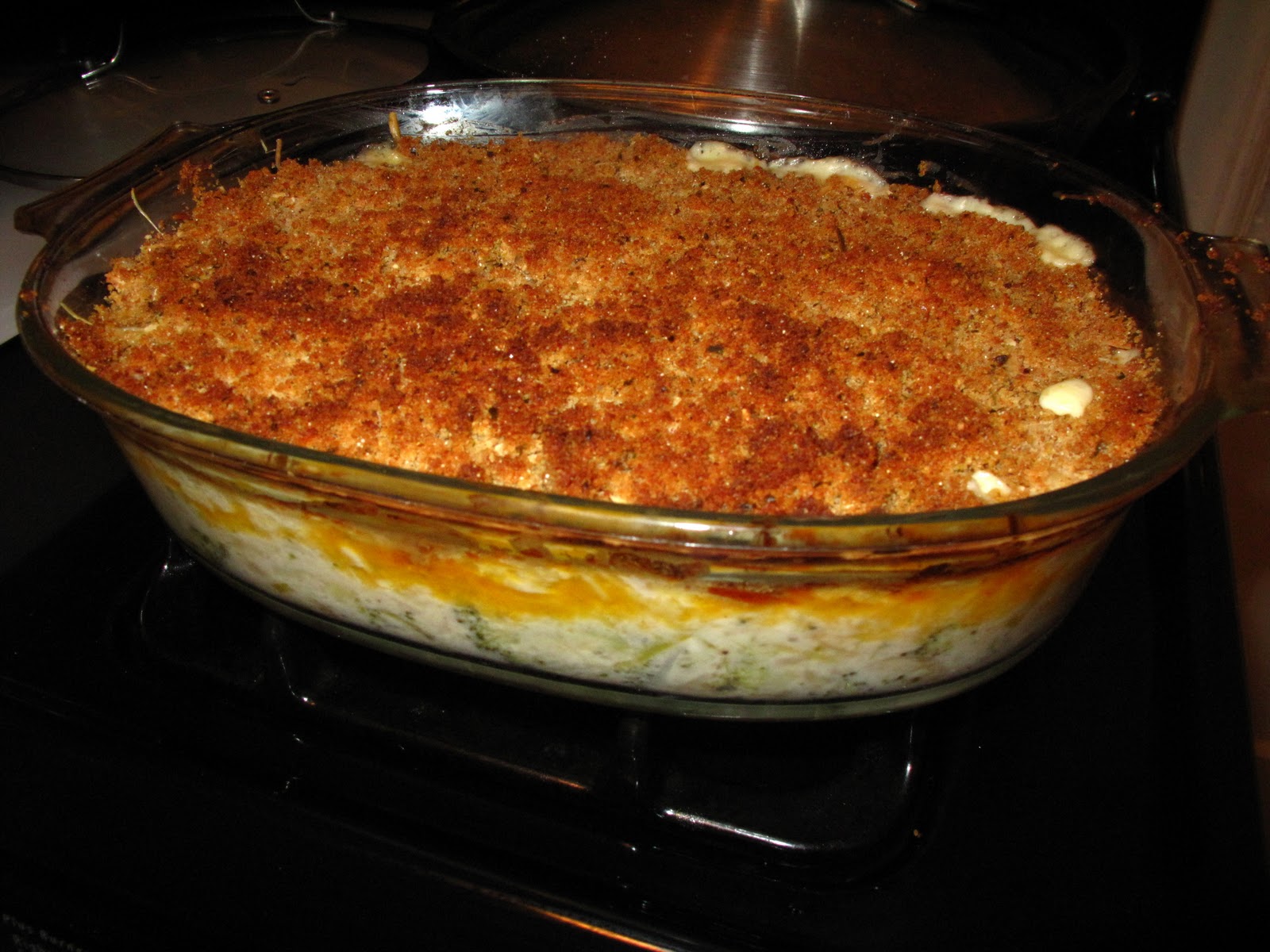
On the same subject: it is actually important to have the broccoli and the chicken in two separate layers. You may be tempted to just mix it all together: what's the difference, right? Well, the difference is that the flavor of the chicken is enhanced by being on the top and getting slightly browned, while being on the bottom layer helps insulate the broccoli from being cooked too much during the baking process. Plus, it looks cool and yummyyummy with the layer of sharp cheddar cheese between the green of the broccoli layer and the golden brown of the chicken layer. Pretty foods taste better: I don't know why, but it's true. It may seem tedious, but it is well worth the extra three minutes it takes in prep time for the end result.

Traditionally, Chicken Divan is made with sherry. Here's the thing: I don't like sherry, and I don't want to spend my money on it: all it would do would be grow dusty in a corner of my cabinet, which for some reason seems wasteful to me. However, I didn't want to completely lose the flavor and texture benefits of a dry alcohol in the sauce. So, I substituted an extremely dry, rich white wine, and thought the result was delicious. So, use the traditional sherry, or substitute white wine if you're more likely to finish a bottle of that than of sherry, or omit it all together if you don't cook with alcohol. Whichever way you decide to go on that, the recipe itself is so solid and flavorful that you won't go wrong.

Chicken Divan
  • 1 stick butter, divided
  • 1T olive oil
  • 1 large leek or two small leeks, cut in half lengthwise and then sliced into crescent-moons (as pictured above) 
  • The dark-green tops of the leeks, washed, rinsed and left whole
  • 1 1/2 lbs. chicken breasts, cut into quarters
  • 1 large head broccoli or three broccoli crowns: washed, rinsed and cut into bite-sized pieces
  • 1/3 cup flour
  • 1 c slivered almonds
  • 1 c light cream
  • 1 cup sour cream
  • juice of 1 lemon
  • 1/3 lb. shredded parmesan cheese
  • 1/4 c sherry or dry white wine
  • 1 c shredded sharp cheddar cheese
  • 1 c bread crumbs
  1. Melt 1 T of the butter in the olive oil in a heavy-bottomed saute pan. Add the leeks and saute over medium heat until they are soft and translucent. Set aside.
  2. Bring 8 cups water to a boil. Add the chicken and the green tops of the leek. Boil until the chicken is fully cooked, approximately 10-15 minutes. Remove the chicken and leek tops with a slotted spoon: DO NOT DRAIN. Discard the leek tops; set the chicken aside to cool some.
  3. Add the broccoli to the water in which the chicken was cooked. Cook only until bright green, 3-5 minutes. Drain, but reserve 1 1/2 cups of the broth for the sauce. Mix the leeks and the broccoli.
  4. Melt 4 T of the butter in a heavy-bottomed saucepan. Add the flour, and stir until smooth and fragrant. Slowly and gradually stir in the reserved broth. Stir in the almonds and cook, stirring constantly, until thick and bubbly. Lower the heat to medium-low. Gradually stir in the cream, sour cream and lemon juice: cook for 2 minutes, still stirring constantly. Add salt and pepper to taste, then stir in half the parmesan and the sherry or dry white wine. Remove from heat. 
  5. Preheat oven to 350 degrees F. 
  6. Shred the chicken into small pieces with your fingers.
  7. Add half the sauce to the chicken, and half to the broccoli. Stir gently but thoroughly. 
  8. Melt the remaining butter, and stir into the breadcrumbs. 
  9. Put the broccoli into a lightly buttered casserole dish. Top with the cheddar cheese, then cover with the chicken mixture. Top the chicken with the remaining parmesan cheese, then distribute the breadcrumbs over the cheese. 
  10. Bake for 30 minutes, until the sauce is bubbly. Increase heat to 450 and cook approximately 10 more minutes until the top is browned. Allow to sit 15 minutes before serving.
 Honey-Mustard Vinaigrette
  • 2 T apple cider vinegar
  • 1/4 c lemon juice
  • 2 T honey
  • 2 T spicy mustard
  • 1 1/2 t tarragon
  • 1/2 c olive oil
  • salt and pepper to taste
  1.  Place the first five ingredients in a blender. Blend over first low, then high speed.
  2. Gradually, in a slow, thin stream, pour the oil through the hole in the lid with the blender still going. Doing this slowly and on high speed will help prevent separation of the ingredients.
  3. Season with salt and pepper to taste: fell free to adjust the amounts of the lemon juice, honey, mustard, tarragon and oil to suit your taste preferences.

24 September 2010

Veggie-ful Rotini-and-Cheese

So, I don't really know anything about the demographics of the writers of other food blogs, but I'm guessing I fall somewhat outside of the norm. This probably true even if we do ignore, for the moment, the obvious traits that distinguish me from the average person in nearly any environment-- you know, the 2nd-generation-Caucasian-American-Buddhist thing and the whole pesky queer-person-with-a-gender-outside-the-binary thing.

You see, being a foodie typically requires a budget that allows for extravagances and the time to dedicate to preparing beautiful recipes that are more "created" than they are "cooked."

Yeah, right. I wish I could do that, and nothing else. However, it is good for you, kind reader, that I can't, because it means that the recipes that I am posting on this blog are, more often than not, simple enough to make amidst the cold, cruel realities of modern life. Yaaaaaay.

I work two jobs: one full time, one part time. I don't do this solely for the joy of being of service to the world: I actually really need the money from both jobs. My boo and I have to do grown-up things like budgeting our money and simplifying expenditures. I'd love to dine on truffle mushrooms and crème fraiche, but the reality is that the pragmatics of the Working Trannies' life make that pretty much impossible.

Sometimes, I get sleepy, and achy, and grumpy, and whiny, and don't feel like making dinner at all. But when you combine the pressure of Lee's first year of law school with the fact that I enjoy cooking, well, you get a situation that involves me cooking a lot.

Sure, we could just go out to eat. However, there are two major downsides to eating out on a regular basis: the first is that it gets really expensive really fast.

Furthermore, when you eat out, the truth is that you don't really know what you're eating. Chances are you didn't research the restaurant's suppliers, and you are probably eating produce from another continent that been sprayed in chemicals and trucked across the nation, deprived of sunlight, and lacking about half of the flavor and nutrients that it once had. Add to that the fact that you have no proof whether or not one of the kitchen employees decided to save a little time by cutting out that pesky "wash-and-rinse-the-produce" step, and who knows anymore whether the benefits of eating that meal really outweigh the costs.

So I do what I can to feed us well. Every once in a while, on a weekend when I don't have to work, I'll gild the lily and really go all-out on a meal. The rest of the time, I just want to make something that's affordable, nutritious, and home-made in whatever time I have available.Of course, the fact that I love to cook does make me willing to spend more time at it than some people would, but the fact remains that I have limited time to work with when it comes to cooking, especially if I want to have dinner ready before midnight (which I usually do).

One important disclaimer: when I think about how healthy a food is or is not, there are some criteria that I consider more personally important than other criteria. I am not terribly worried about low-fat, low-calorie considerations. In fact, I think that the cultural obsession with low-fat and low-calorie diets has resulted in so many people eating pre-prepared, chemically altered, packaged "foods" that have been designed not by nature, but by a lab. Nitrates, nitrites and sulfates abound. Partially hydrogenated substances that are the biological equivalent of pouring sand into a watch are guzzled down gullets with enthusiasm. People no longer know how their food was grown, whether it is in season, where it came from, or what's in it.

If you do choose to substitute one of the ingredients in my recipe for a more low-fat or vegan alternative, well, do what you have to do. But I would suggest making sure that you educate yourself as to the exact ingredients of what you're adding, and consider where the ingredients were produced.

I am going to reiterate something I wrote in an earlier post: "The energy we take into our body has a direct, undeniable connection to the energy we have to use in the world, and it is my hope that the forward-thinking revolutionary queers will all be filled with the best possible fuel for changing the world." It would be very sad if our culture and our community lost their connection to our sources of life-sustaining energy. Don't let that happen to you. 

What I do consider when making meals that will nourish is whether or not the food is in season, whether or not it is growing locally, and whether or not the foods that I am going to prepare create a well-balanced meal.

Some tips for this recipe: don't overcook the pasta. Given the baking time that happens after you cook the noodles, make sure they are al-dente, or even a little shy of al-dente. Unless you want to eat cheesy mush. Which just isn't as good as cheesy pasta.

Change the vegetables that you put in it based upon what is fresh where you live. Right now, Lee and I still have tomatoes growing in our backyard, which is nice. Once tomatoes go out of season, they go out of the recipe. It's just that simple. Winter tomatoes are gross, while imported tomatoes are grown in an unappetizing pesticide marinade. Blech. There are many things I enjoy putting in my mouth: crunchy tomatoes and pesticides are not among them.

Use whatever shape and size of pasta you want, other than lasagne noodles and manicotti shells, which just wouldn't work for this recipe (but will be used in future recipes, I promise!). Just make sure you don't overcook them.

If you want to add some fresh herbs, I suggest tarragon, basil, or dill, approximately 2 T (chopped coarsely) per batch. But don't feel obligated. Sometimes just a simple mac-and-cheese is all that is called for, without pretension or adornment.


With that said, what follows is a delicious, economical dish that is simple and quick to make. It is not low-fat. And yet, it is still nourishing. Enjoy.

Adapted from my grandmother's recipe.

 Veggie-ful Rotini-and-Cheese

  • 1 pound rainbow rotini (or other pasta), cooked just short of al-dente
  • 1 pound sharp cheese, shredded (the tried-and-true standard is sharp cheddar, but feel free to experiment with other cheeses, or to substitute 6 oz. goat cheese for some of the shredded cheese)
  • 2 1/2 cups light cream or whole milk
  • 3-4 T unbleached all-purpose flour
  • 8 oz. baby 'bella mushrooms, chopped coarsely and sauteed
  • 6 oz. baby spinach, chopped coarsely and sauteed just until it is soft and dark green
  • 2 plum tomatoes or 1 heritage tomato, sliced very thinly
  • salt and pepper to taste
  1.  Preheat oven to 375 degrees F.
  2. Put the cheese, cream or milk, and flour in a large, heavy-bottomed saute pan. Melt over low heat, stirring constantly, until the cheese is melted and the mixture is hot. Season to taste with salt and freshly ground pepper. Stir in the mushrooms, spinach and tomatoes.
  3. Mix the sauce into the pasta until it is evenly distributed. 
  4. Pour the pasta into a large baking dish or two medium baking dishes. 
  5. Bake in the preheated oven 25-30 minutes, until the top is lightly browned and slightly crunchy and the sauce is bubbling happily. 
  6. Let sit for 10 minutes before serving. 

21 September 2010

Beet, Wild Mushroom and Potato Casserole: A Delicious Fall Dish

I think most families have few recipes that are so tried-and-true, so delicious and hearty and satisfying, that they become worked into the meal rotation with great regularity. This can almost get to the point where some dishes are so liked and so familiar that they almost become default meals. 

("What do you want for dinner?" "I dunno, what do want?" "I dunno." "How 'bout we have __(fill in the blank)__?" "Good idea. Let's have that.")

In our home, this dish is the answer to the question of what to have for dinner more often than almost any other, especially this time of year. It is literally a dish you cannot mess up. Every time I make it, I make it a little bit differently than I did the time before, and it is always delicious.

With that said, I do have a few suggestions. When you cut the beets and onions, leave them in nice, big chunks: this dish is more satisfying when it's full of big, flavorful beety hunks of mmmmmmmmm. 

Feel free to experiment with what herbs you use, but don't leave out the dill, horseradish, or caraway seeds. They really bring all the flavors together.

Finally, don't rush the onions. Never be in a rush when you are sauteeing onions: allow them to cook until they are soft and see-through, and until their flavor is a little sweet, lowering the heat if you have to to prevent them from burning. When something (or someone) is as pungent as a freshly-chopped onion, it can take a little bit of time to get it (or him, her or hir) to mellow out. The end result of your dish will be much improved by being willing to allow a little extra time to this step.

Beet, Wild Mushroom and Potato Casserole 
  • 2 T vegetable oil   
  • 1 large onion, chopped  
  • 1 t caraway seeds  
  • 2 T all-purpose flour  
  • 1/3 cup water  
  • 1/3 cup dry white wine  (OR: omit water and wine, substitute vegetable stock)  
  • 1 1/2 pounds cooked beets, peeled and cut into large bite-sized pieces  
  • 5 T light cream  
  • 2 T creamed horseradish (or to taste: I sometimes prefer a little more)  
  • 1 t hot mustard  
  • 1 T wine vinegar  
  • 2 T butter  
  • 1 shallot, chopped  
  • 8 oz. assorted wild mushrooms (or, to simplify, baby 'bellas work well: though it's best if there are some oyster mushrooms in it!)  
  • 3 T fresh parsely, chopped  
  • 2 t each: fresh basil, marjoram, dill and oregano, chopped  
  • Salt and pepper, to taste     
For the potato border: 
  • 2 lbs. potatoes, preferably Yukon Gold or red potatoes, chopped into largish bite-sized chunks (leave peels on)  
  • 1/2 c milk  
  • 1/4  c butter  
  • 1 T fresh dill, chopped  salt and freshly ground pepper, to taste     

OVEN TEMP: 375 degrees F

1. Lightly oil a 9 inch round baking dish, or similarly-sized casserole dish. Heat the oil in a large saucepan: add the onion and cook until soft. Add caraway seeds and saute a few more minutes, until fragrant. Stir in the flour, remove from heat, and gradually add the water and wine (or stock), stirring until well-blended. Season to taste with salt and pepper.

2. Return to the heat: stir and simmer to thicken, then add the beets, cream, creamed horseradish, mustard and vinegar. Stir to mix.

3. Bring the potatoes to a boil in salted water and cook for 20 minutes. Drain well and mash wth the milk and butter. Add the dill and season with salt and pepper.

4. Spoon the potatoes into the prepared dish and make a well in the center. Spoon the beet mixture into the well and set aside.

5.Melt the 2 T butter in a large nonstick frying pan and cook the shallot until soft, without browning. Add the mushrooms and cook over medium heat until their juices begin to run. Increase the heat and boil off the moisture. When quite dry, season with the herbs and salt and pepper to taste.

6. Spread the mushrooms over the beet mixture, cover the dish with a lid or a piece of aluminum foil, and bake for about 30 minutes. Serve immediately, garnished with parsley if you desire.

This entire dish can be prepared in advance and baked when needed. Allow more baking time (approx. 15-20 minutes more) when baking from room temperature.

20 September 2010

Eggplant, Smoked Mozzarella and Basil Rolls

So, the first time I made these, I sliced the eggplant and tomatoes too thick, and I ended up with blobs of what was basically Italian baba ganoush. It was very yummy, but not exactly what I was hoping for aesthetically. The second batch turned out much better.

The moral of the story is: size matters, but not always in the same way. Don't get over-enthusiastic: make your  slices thin.

Ready to roll!
Eggplant, Smoked Mozzarella and Basil Rolls

  • 1 large eggplant
  • olive oil
  • 6 oz. smoked mozzarella cheese, sliced into 8 thin pieces
  • 2 plum tomatoes, each cut into 4 thin slices
  • 8 large basil leaves
  • balsamic vinegar, for drizzling
  • salt and freshly ground black pepper
  1. Cut the eggplant lengthwise into 10 thin slices and discard the two outermost slices. Sprinkle the slices with salt and leave for 20 minutes. Rinse, then pat dry with paper towel.
  2. Preheat the broiler and line the rack with foil. Place the eggplant slices on the grill rack and brush liberally on both sides with olive oil. Broil for 8-10 minutes until tender and golden, turning once.
  3. Remove the eggplant slices from the broiler, then place a slice of mozzarella and tomato and a basil leaf in the center of each eggplant slice, and season to taste with salt and pepper. Fold the eggplant over the filling and broil, seam-down, until heated through and the mozzarella begins to melt, about 5 minutes. Serve drizzled with olive oil, if desired, and a little balsamic vinegar.